Stability of Geodesic Vectors in Low-Dimensional Lie Algebras
2022A. K. Nguyen and Y. Nikolayevsky
Journal of Lie Theory 32, No. 4, 1111–1123
— Kyan
PhD Student in Pure Mathematics
La Trobe University, Melbourne, Australia
My research lies in differential and Riemannian geometry, with particular interests in symmetry, homogeneous and symmetric spaces, Killing tensors, and geodesic flows. More broadly, I am interested in the geometric structures connecting curvature, topology, Lie theory, integrable systems, and mathematical physics.
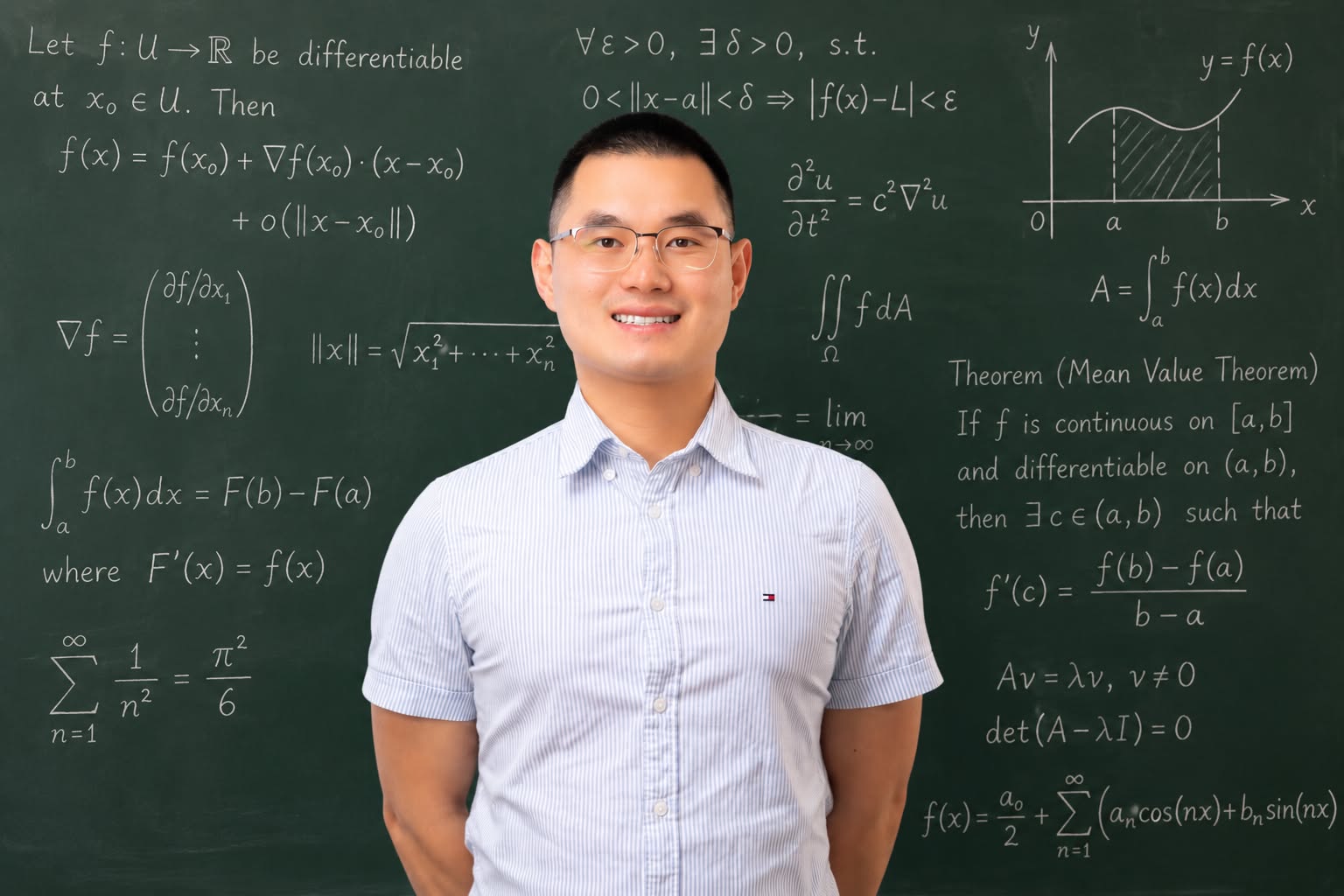
I am a PhD student in Pure Mathematics at La Trobe University, working in differential and Riemannian geometry. My current research focuses on symmetry in geometric spaces, including quadratic Killing tensors on symmetric spaces and homogeneous quotients of compact Lie groups. I am particularly interested in understanding when higher-order conserved quantities are generated by classical isometries, and how geometric symmetry behaves under metric deformation and quotient constructions.
At the heart of my work is a fascination with curvature, symmetry, and the hidden structures that govern geometric spaces. I am drawn to problems where geometry and topology meet Lie theory, integrable systems, and mathematical physics, and where deep conceptual questions can be approached through a combination of structural insights and explicit computations.
My long-term ambition is to develop a research programme in Pure Mathematics around the geometry of symmetry, curved spaces, and integrability, guided by the structural questions that continue to shape modern differential geometry.
I work at the intersection of Riemannian geometry, Lie theory, and integrable systems.
My current PhD research studies the decomposability of quadratic Killing tensors on Riemannian symmetric spaces: a problem about whether higher-order conserved quantities of the geodesic flow are genuinely new, or already forced by the classical symmetries of the space. In this setting, decomposability means that every quadratic Killing tensor can be generated from Killing vector fields, so that apparent hidden symmetries reduce to the visible geometry of the isometry group.
My work develops a structural and computational approach to this problem across major families of symmetric spaces. Building on the top-slot model of Vladimir Matveev and Yuri Nikolayevsky, I construct novel Lie-theoretic reductions, induction arguments through totally geodesic submanifolds, and exact algebraic computations. In this new framework, the overdetermined Killing tensor equation is transformed into a finite-dimensional decomposability problem, where geometric structures and rigorous SageMath computer algebra come together to give a complete and affirmative resolution of the problem across ALL compact classical symmetric spaces.
Wolf’s Homogeneity Conjecture concerns Riemannian quotients of homogeneous spaces by discrete groups of isometries of constant displacement. It proposed that if every deck transformation is a Clifford-Wolf translation, then the quotient should itself remain homogeneous. Xu and Deng recently disproved the conjecture through a counterexample on the compact Lie group Sp(2).
My current work investigates the broader geometric mechanism behind this phenomenon on compact Lie groups and develops infinite families on Sp(n) and SU(2k). For every prescribed cyclic order N ≥ 3, the construction uses suitable left-invariant metrics close to a bi-invariant metric for which every element of the cyclic deck group has constant displacement, while the resulting quotient is non-homogeneous.
The proof brings together constant-length Killing fields, a uniform persistence theorem for globally minimising geodesics under metric deformation, the structure of connected isometry groups of left-invariant metrics, covering-space arguments, and exact centraliser-stabiliser dimension calculations. The project is currently a working manuscript undergoing expert mathematical review.
I worked on homogeneous geodesics, Euler dynamics, and stability in low-dimensional Lie groups.
My Master's research studied homogeneous geodesics on Lie groups equipped with left-invariant Riemannian metrics. In this setting, the geometry of geodesics can be translated into Lie-algebraic dynamics: after left translation to the identity, the geodesic equation becomes the Euler equation on the Lie algebra, and geodesic vectors appear as its equilibrium points.
This work led to a joint paper with Yuri Nikolayevsky, in which we gave a complete classification of Lyapunov stable and unstable geodesic vectors for metric Lie algebras of dimension 3 and for unimodular metric Lie algebras of dimension 4.
A. K. Nguyen and Y. Nikolayevsky
Journal of Lie Theory 32, No. 4, 1111–1123
A. K. Nguyen and Y. Nikolayevsky
Manuscripts in preparation
A. K. Nguyen
Manuscripts in preparation
A record of recent talks, workshops, and academic visits.
International Congress of Mathematicians, Philadelphia, USA
A poster presenting the proof that every quadratic Killing tensor on the compact classical Lie groups SO(n), Spin(n), SU(n), and Sp(n), with bi-invariant metrics, is decomposable.
OzGeomPDE Student Symposium, MATRIX, Creswick, Australia
A talk on the decomposability problem for quadratic Killing tensors on compact Lie groups, focusing on the SU(n) case and the algebraic reduction behind the proof.
MATRIX, Creswick, Australia
A research program on Nijenhuis and Haantjes geometries, separation of variables, and their connections with integrable systems.
69th AustMS Annual Conference, La Trobe University, Melbourne, Australia
A talk on the decomposability problem for quadratic Killing tensors on Riemannian symmetric spaces and recent progress in higher-rank cases.
VIII Conference on Finite Dimensional Integrable Systems, CIMAT, Guanajuato, Mexico
A talk presenting the decomposability result for quadratic Killing tensors on SO(n) and Spin(n).
Selected scholarships, grants, and recognitions supporting my research and academic development.
Full tuition offset and stipend supporting doctoral study in Pure Mathematics at La Trobe University.
Departmental award supporting international research activity in geometry.
Selected for international laureate forums recognising emerging researchers in mathematics.
Awarded for research activity and conference participation.
Recipient of the Professor Ed Smith Travel Award at the 2026 Student Prize Ceremony.
An interview on mathematical research, motivation, and international scientific exchange.
A report on the mathematical programme and young-researcher experience at the 9th Heidelberg Laureate Forum.
A research report on geodesic stability for three-dimensional unimodular metric Lie groups.
University teaching, mathematical mentoring, and academic support across higher education.
STM1001, La Trobe University, 2024–present
Design and deliver interactive mathematics and statistics tutorials, assess student coursework, and develop supplementary instructional materials for undergraduate STEM students.
Victoria University, 2023–present
Provide academic mentoring and develop learning resources that strengthen students' mathematical reasoning, problem-solving skills, and confidence in quantitative subjects.
Simon Marais Mathematics Competition, 2024–present
Serve as a senior marker for the Simon Marais Mathematics Competition, a university-level competition widely regarded as the Putnam Competition of the Southern Hemisphere.
2017–present
Provide private mathematics instruction across all school year levels, with extensive experience guiding students from foundational mathematics through to Year 12 VCE. My teaching emphasises conceptual understanding, structured problem-solving, and targeted preparation for senior VCE examinations.
For research correspondence, collaboration, seminar invitations, and teaching enquiries.